


Shanmukhi Mudra
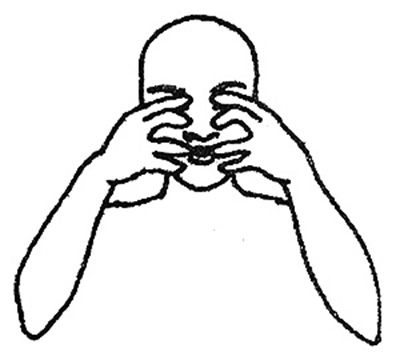
Technique:
Using the fingers of both hands press the ears with thumbs, eyes with index fingers, nostrils with middle fingers and mouth with ring fingers. (Place little fingers near the chin) The main pressure is on the ears and eyes. You can experiment with pressure on the eyes until light can be seen - either direct pressure on the eyeball or inward and upward pressure toward the third eye.
To breathe, release the right middle finger from the right nostril and inhale. Close the nostril and again and hold the breath as long as possible without straining. Then exhale through the mouth making noise like wind. Do this three times and rest. Breathe normally with eyes closed. Then do another round of three. Do not do more than this since it creates much heat and is very stimulating.
Comments and Variations:
With the inhalation through the right nostril (pingala - sun side), much heat is created which stimulates the kundalini and allows for more ease in seeing inner light. However, in times of high blood pressure or anger or any “hot” state, the following variation will be more calming and peaceful: using the fingers to block the senses the same as shown above, simply inhale through both nostrils by releasing the middle fingers. Hold the breath and close the nostrils, then exhale through both nostrils by releasing the middle fingers again. This may be practiced 10 to 20 minutes.
Shanmukhi Mudra is very useful in preparing us for meditation. We are always involved with the gross senses; our focus is on the outer world. Shanmukhi Mudra helps us to tune into the inner world by awakening the inner senses. “Shan” means six; “mukhi” means mouths (doors); “mudra” means pose. We have six doors to the outer world - two ears, two eyes, one nose and one mouth. If we close these six then we have control of the senses. We can see inner light and hear inner sound - which make up our essence.
This is normally practiced before meditation. When a busy schedule may not permit time for meditation, then occasionally this mudra may replace meditation because of its centering effect.
The various lights or colors seen during the mudra correspond with the element governing you at that particular times ( earth - yellow, water - white, fire - red, air - blue, space - smoky). The various sounds heard during the mudra include: ocean, waterfall, flute, wind, etc.